HSX BLOG
Why Are Some Aluminum Die Castings Anodized While Others Need Conductive Conversion Coating?
Many drawings say only “oxidize” or “anodize,” but anodizing and what some workshops call “conductive oxidation” solve different problems. Anodizing is usually chosen for oxide-film protection, hardness, wear resistance and metallic appearance. Conductive chemical conversion coating is usually chosen for thin-film
Many drawings say only “oxidize” or “anodize,” but anodizing and what some workshops call “conductive oxidation” solve different problems. Anodizing is usually chosen for oxide-film protection, hardness, wear resistance and metallic appearance. Conductive chemical conversion coating is usually chosen for thin-film corrosion control, paint adhesion and lower electrical contact resistance. Treating them as interchangeable can produce a sample that looks acceptable but later fails grounding, shielding, fit or wear requirements after assembly.
Quick answer: When a part needs hardness, wear resistance, a metallic appearance or a more substantial oxide layer, anodizing is usually evaluated. When it needs grounding, EMI shielding, low contact resistance, a paint base or minimal dimensional change, conductive chemical conversion coating is usually evaluated. Neither route is universally better. The correct choice depends on the failure risk to control and the function that must remain.
1. First, Clarify the Terminology: “Conductive Oxidation” Is Usually Not Anodizing
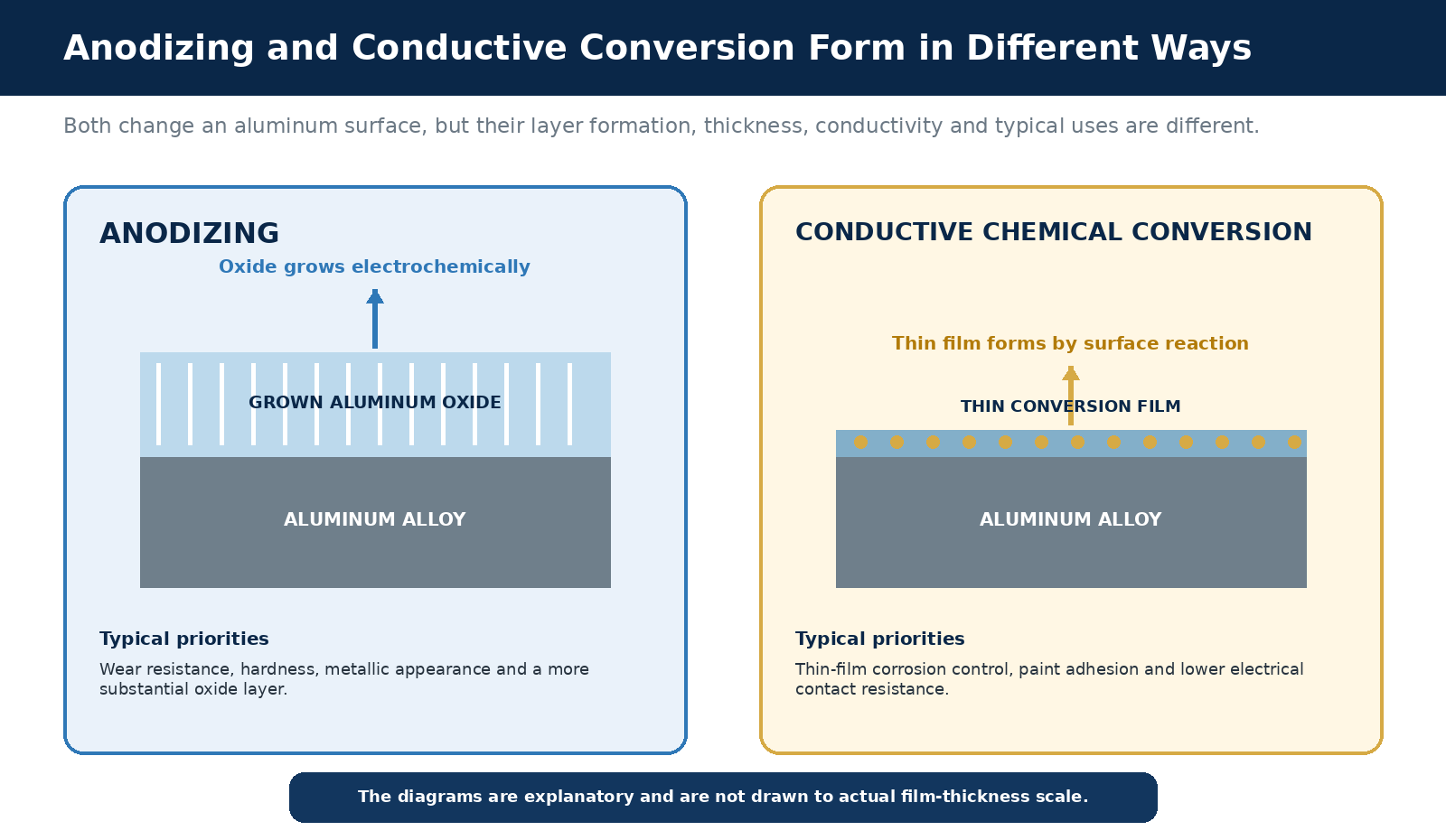
In Chinese shop-floor and purchasing discussions, “conductive oxidation” is a common phrase. In English-language engineering communication, conductive chemical conversion coating is usually the more precise term. It forms a very thin conversion film through a chemical reaction between the aluminum surface and the treatment solution. It is not ordinary anodizing made electrically conductive.
Anodizing is an electrochemical oxide-growth process. The aluminum part acts as the anode in an electrolytic system, and an aluminum oxide layer grows from the surface and remains integrated with the substrate. That oxide can provide protection, hardness, wear performance or appearance value, but aluminum oxide is also a dielectric material and therefore increases electrical contact resistance.
A drawing that says only “oxidize” is incomplete. The engineer should state whether the part needs appearance, wear resistance and corrosion protection, or whether it must preserve grounding, shielding and low-resistance electrical contact.
2. What Problems Does Anodizing Mainly Solve?
Anodizing is commonly considered when an aluminum part needs a more substantial oxide layer, increased surface hardness, better wear resistance or a controlled metallic appearance. It can be a reasonable route for visible parts, lightly rubbed surfaces, decorative components or parts that need a more stable anodic film.
For a broader finishing comparison, the guide to powder coating vs anodizing for aluminum die casting explains how appearance, corrosion exposure, dimensional interfaces and alloy condition influence the choice.
However, anodizing also creates effects that must be designed and inspected:
Electrical contact is affected. Grounding points, shielding faces and electrical interfaces may require masking or a different treatment.
The oxide layer changes holes, threads, mating faces and sealing dimensions. Tolerances cannot be based only on the as-cast or machined condition.
Color and appearance depend on alloy composition, porosity, surface preparation, pretreatment and casting condition.
Anodizing does not automatically hide flow marks, pits, inclusions, peeling or inconsistent grinding. Some defects become more visible after treatment.
3. What Problems Does Conductive Chemical Conversion Coating Mainly Solve?
Conductive chemical conversion coating produces a much thinner film and is usually selected to balance corrosion protection, paint adhesion and lower electrical contact resistance. It is often considered for electronic housings, grounding faces, shield connections, internal brackets and dimension-sensitive interfaces.
The word “conductive” does not mean that the treated surface behaves exactly like freshly machined bare aluminum. It also does not mean that every joint will automatically satisfy an electrical requirement. Results still depend on the coating class, surface roughness, contact pressure, flatness, fastening method and test method.
Conductive conversion coating has its own boundaries:
Wear and heavy-friction resistance are normally lower than with anodizing. It should not be treated as a hard wear layer.
The film is very thin and has limited ability to mask the substrate. Alloy color, casting texture and pretreatment differences may remain visible.
When corrosion requirements are demanding, the coating class, paint system or other protective route should be defined instead of writing only “conductive oxidation.”
Grounding and shielding performance should be confirmed by a specified contact-resistance or assembly test, not by color alone.
4. How Do the Two Treatments Differ in Practice?
Layer formation: Anodizing grows an aluminum oxide layer electrochemically. Conductive conversion coating forms a thin reaction film through surface chemistry.
Primary purpose: Anodizing emphasizes wear, hardness, appearance and oxide-film protection. Conductive conversion emphasizes thin-film corrosion control, paint base performance and lower contact resistance.
Electrical behavior: Anodizing generally increases insulation and often requires masking at contact areas. Conductive conversion is more suitable for grounding, shielding and low-resistance contact zones.
Dimensional influence: Anodizing must be included in hole, thread and fit tolerances. Conductive conversion usually has a smaller dimensional effect, although the governing requirement still needs to be confirmed.
Wear performance: Anodizing is normally stronger for abrasion and can be further evaluated as hard anodizing. Conductive conversion is not intended for severe rubbing.
Appearance: Anodizing can create a metallic or dyed appearance, but the result depends heavily on alloy and surface condition. Conductive conversion is thin, so substrate and pretreatment differences remain visible.
Common risks: Anodizing can cause electrical isolation, dimensional interference, color variation or stronger visibility of casting defects. Conductive conversion can suffer from unstable contact resistance, inadequate wear or inconsistent film control.
5. Three Buyer Scenarios Where “Treat the Whole Part” Is Not Enough
Scenario 1: An electronic housing needs grounding or EMI shielding
If the housing supports grounding, shielding or electrostatic discharge, metal contact must be preserved at mounting faces, screw-clamping areas and connector interfaces. Anodizing the entire part can create a uniform appearance while increasing contact resistance. A better route may be conductive conversion coating, local masking, or a defined contact-resistance test after treatment.
Scenario 2: A visible or lightly rubbed part prioritizes wear and metallic appearance
For an exposed part that needs metallic appearance, some wear resistance or a more stable oxide layer, anodizing may be evaluated. The decision must still account for the die-cast alloy, as-cast surface, color-difference limits and actual sample result. The appearance expected from an extrusion or a machined wrought alloy should not be copied directly onto a die casting.
Scenario 3: One part has visible faces, conductive zones and precision interfaces
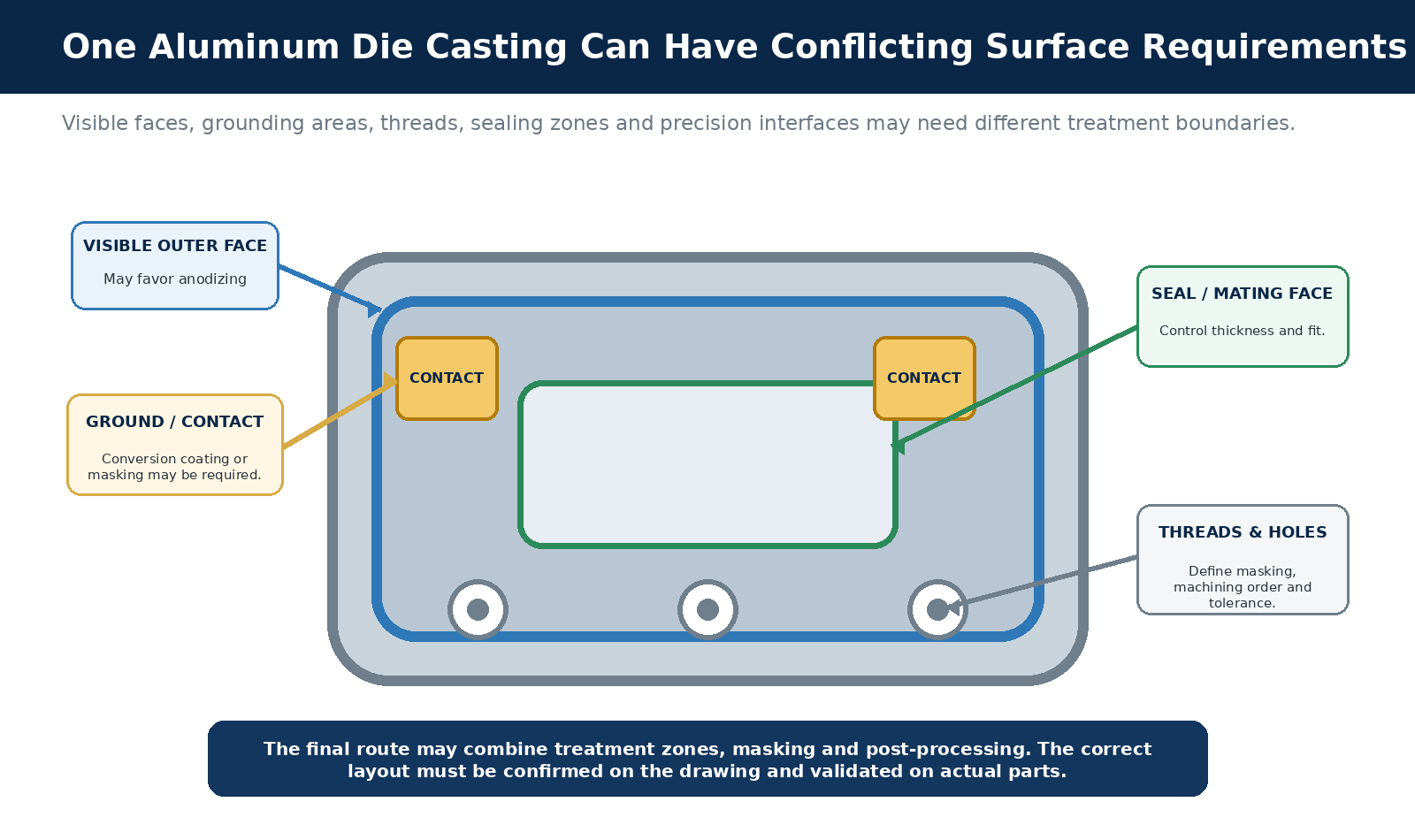
These parts normally need functional zoning. The visible outer surface may be anodized, grounding faces may need conductive conversion or masking, and threads, holes and sealing faces may require tight film-thickness control. In this situation, cost and production stability are driven less by the process name than by zoning, masking, machining sequence and acceptance method.
6. Why Can Die-Cast Aluminum Not Simply Copy the Experience of Extrusions or Machined Aluminum?
The aluminum die casting process uses alloys and solidification conditions chosen for filling, strength and repeatable production. Die castings may also contain porosity, local segregation, flow-related traces and differences in the dense surface skin. These factors influence pretreatment, film growth, color and appearance uniformity.
Anodizing results on a casting therefore cannot be predicted from the process name alone. Even if two drawings both specify “black anodize,” different alloys, casting conditions, grinding methods or blasting routes can produce different colors and surface appearances. Conductive conversion coating is also affected by alloy, cleaning and surface condition, and a uniform color does not by itself prove corrosion or electrical performance.
For projects with demanding appearance, sensitive contact resistance or defined salt-spray requirements, samples and tests should use the actual part, actual alloy and actual pretreatment route rather than relying only on standard test panels.
7. How Do These Requirements Affect an Aluminum Die Casting Quote?
The price difference between anodizing and conductive conversion coating cannot be reduced to “which one is cheaper.” For a custom aluminum die casting supplier, the quotation depends on the complete treatment scope and the inspection burden.
The main cost drivers usually include:
The area, location and complexity of masking.
Whether machining or cleaning must be added before or after treatment.
Color, appearance, film thickness, salt-spray or contact-resistance requirements.
Whether reference panels, limit samples or multiple trial rounds are required.
Whether the geometry can trap solution, create rack-contact marks or produce appearance dead zones.
The required batch consistency for color, electrical contact and assembled dimensions.
If a drawing says only “oxidize,” each supplier must make its own assumptions. The resulting aluminum die casting quotes may reflect completely different routes and therefore cannot be compared fairly.
A structured RFQ checklist for custom OEM aluminum die casting parts helps buyers define finish, alloy, quantity, critical interfaces and acceptance requirements before comparing quotations.
8. What Should Buyers and Engineers Define on the Drawing or RFQ?
An aluminum die casting manufacturer can only choose and control the right route when the drawing identifies both the required surface function and the areas where that function applies.
Base alloy and whether the alloy may be adjusted to meet the surface-treatment target.
Service environment: indoor, outdoor, humidity, salt spray, chemicals, friction or temperature cycling.
Primary objective: corrosion protection, wear resistance, appearance, insulation, grounding, shielding or paint adhesion.
Which faces are visible, and which are grounding, sealing, assembly, threaded or hole surfaces.
Required film thickness, color, gloss, color-difference, contact-resistance or salt-spray standard.
Masking areas, rack-contact points and allowable appearance traces.
Sample-approval method and mass-production consistency requirements.
When anodizing, conversion coating or other specialized finishing is required, the approved route may also involve additional manufacturing support . The treatment scope, masking, tests and final responsibility should still be defined before production.
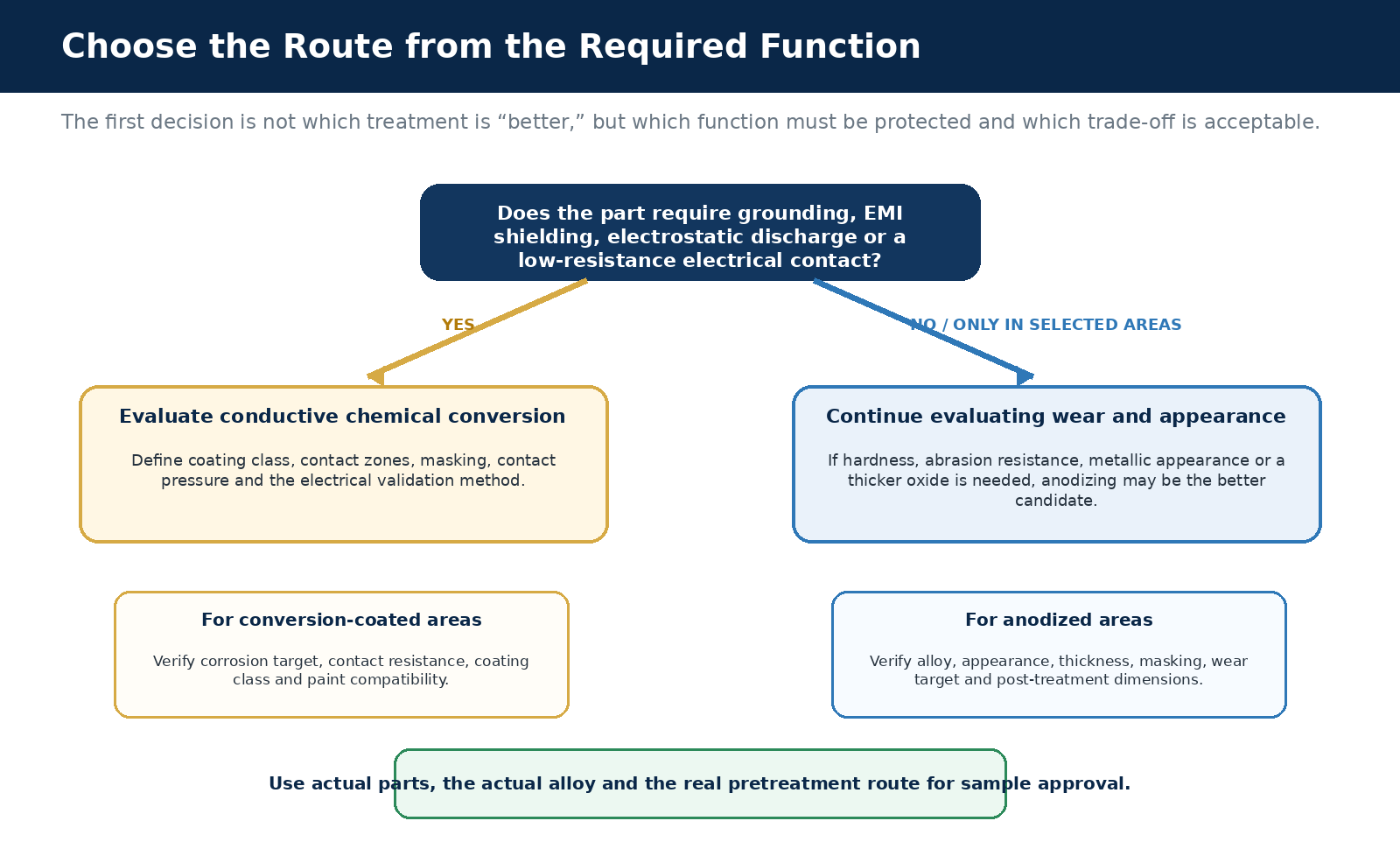
Conclusion: Define the expected failure and the function that must remain before choosing anodizing, conductive chemical conversion coating or a zoned combination. No single treatment can optimize wear resistance, conductivity, appearance, dimensions and cost at the same time.
Related HSX evidence
Keep the finish choice tied to enclosure contacts, assembly interfaces and the drawing, with the required partner-supported process confirmed for the project.
Continue reading
Convert general guidance into a project-specific review.
Share a drawing, 3D file, sample or requirement so HSX can review the actual geometry, process route and finishing boundary.