HSX BLOG
What Problem Should Surface Treatment Solve on an Aluminum Die Casting?
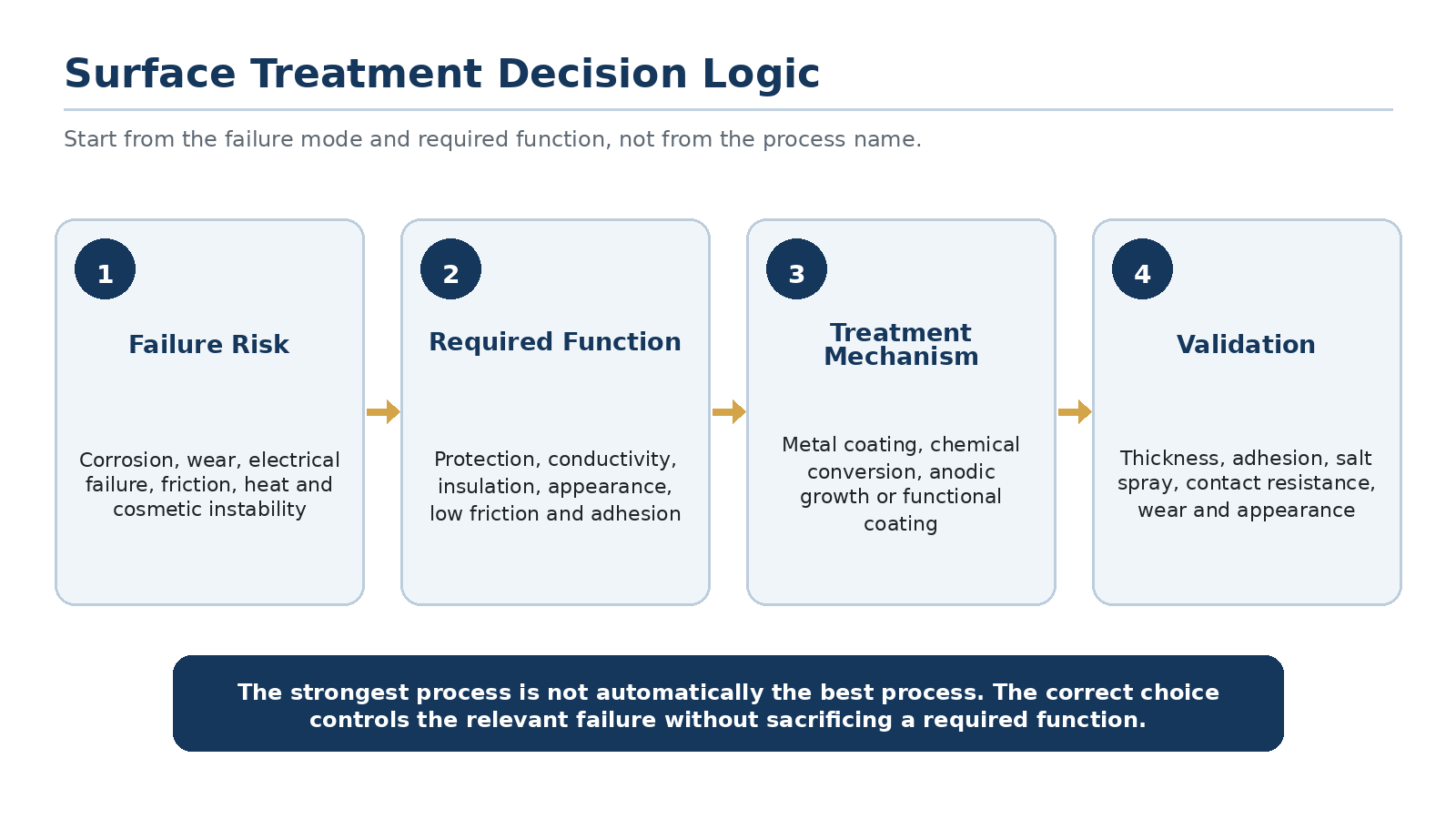
Surface treatment should be selected from the failure risk and required function of the part, not from the process name alone. An aluminum die casting may need corrosion protection, wear resistance, electrical conductivity, insulation, lower friction, coating adhesion, a controlled appearance, or several of these at
Surface treatment should be selected from the failure risk and required function of the part, not from the process name alone. An aluminum die casting may need corrosion protection, wear resistance, electrical conductivity, insulation, lower friction, coating adhesion, a controlled appearance, or several of these at the same time. The correct process is the one that controls the relevant failure without creating a new problem in assembly, electrical contact, dimensions, or mass-production consistency.
During product development, drawings often specify anodizing, conductive conversion, passivation, nickel plating, or bluing before the actual surface risk has been defined. These treatments may all create a protective surface, but they form in different ways, have different cost structures, and can change the function of the finished part in very different ways.
A reliable aluminum die casting manufacturer should therefore ask two questions before confirming a finish: What can fail at the surface, and what must the part still be able to do after treatment?
1. Start with the Failure Mode, Not the Process Name
For buyers and product engineers, surface treatment is not a decorative label added to a drawing. It is a way to control a defined set of risks. The target may be corrosion resistance, wear resistance, lower friction, electrical insulation, electrical continuity, stronger paint adhesion, stable color, or protection against humidity, salt spray, chemicals, abrasion, and temperature cycling.
One treatment can solve one problem while creating another limitation. A thicker oxide layer can improve hardness and protection, yet interfere with electrical contact or assembly dimensions. A metallic coating can add wear resistance or a new appearance, yet poor pretreatment, weak adhesion, pores, or cracks can lead to blistering, peeling, and localized corrosion.
2. Four Common Surface-Treatment Mechanisms Solve Different Problems
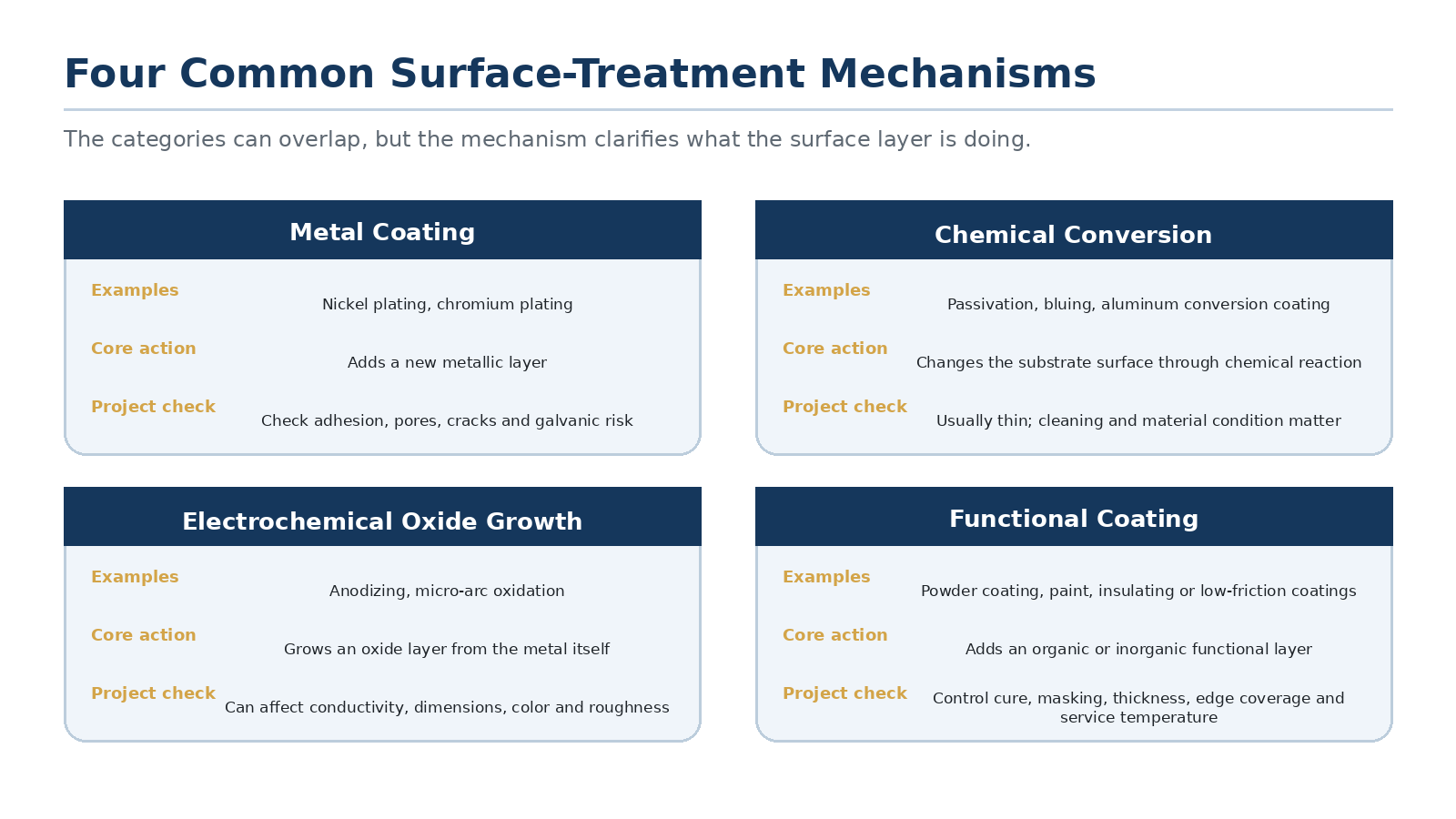
A practical way to organize surface treatments is by the main mechanism that creates the surface layer. The categories are not absolute, and some production routes combine more than one mechanism, but the framework helps clarify where the new surface comes from, what it is expected to do, and what the project may sacrifice.
Metal coatings
Electroplated nickel, electroless nickel, chromium plating, and similar processes add a new metallic layer over the substrate. The part gains properties associated with the deposited metal, such as corrosion resistance, wear resistance, appearance, or another functional surface. The complete system still depends on pretreatment, adhesion, coating continuity, pore control, thickness, and the galvanic relationship between coating and substrate.
Chemical conversion coatings
Passivation, bluing, and aluminum conversion coatings do not build a separate metallic shell in the same way as plating. They form through a chemical reaction with the substrate surface. These films are commonly used to reduce corrosion risk, create a paint base, stabilize the surface, or maintain relatively low electrical contact impedance.
Electrochemically grown oxide layers
Anodizing and micro-arc oxidation use electrochemical energy to grow an oxide layer from the metal itself. They can improve protection, hardness, wear performance, and certain appearance characteristics, but the oxide layer can also affect conductivity, dimensions, color, roughness, and later assembly.
Functional coatings
Powder coating, liquid paint, insulating coatings, low-friction coatings, and other specialized layers solve a broader range of functional needs. These processes require control of cleaning, adhesion, cure, masking, film build, edge coverage, and service temperature.
3. Why Some Aluminum Parts Are Anodized and Others Need Conductive Conversion
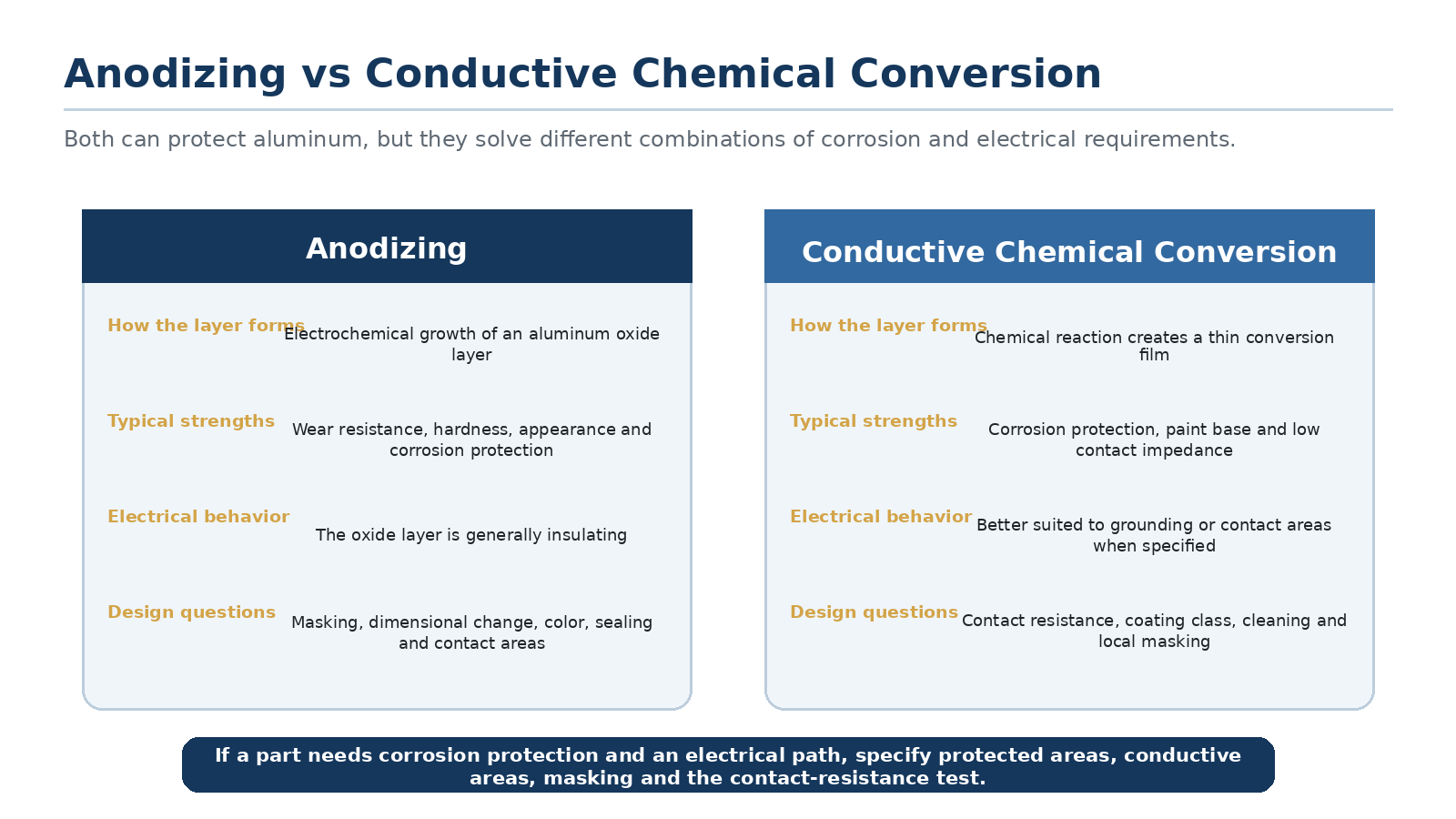
These two requirements are frequently confused in aluminum die casting quotes and drawing reviews. Anodizing grows an aluminum oxide layer by an electrochemical process. It is commonly considered when the project needs improved surface protection, wear resistance, hardness, or a controlled metallic appearance. Because aluminum oxide is generally electrically insulating, treated mounting faces, grounding points, and contact areas may no longer meet the electrical requirement.
The shop term "conductive oxidation" usually refers more accurately to a conductive chemical conversion coating on aluminum. The film is thinner and is intended to provide a combination of corrosion protection or paint-base performance while retaining lower electrical contact impedance. It should not be treated as a conductive version of ordinary anodizing.
If a part needs both corrosion protection and an electrical path for grounding or electromagnetic shielding, the drawing should identify treated areas, masked areas, conductive interfaces, and the contact-resistance acceptance method. A single note saying "oxidize the whole part" is not enough.
4. Why Nickel Plating on Magnesium Is More Difficult Than "Nickel Resists Corrosion"
Magnesium alloys are highly reactive, and their surface can change rapidly during cleaning, etching, activation, and transfer into the plating bath. A stable nickel layer requires pretreatment that removes an unstable surface without allowing uncontrolled attack, while also creating a reliable interface for deposition.
If pretreatment, activation, or an intermediate layer is inconsistent, the nickel coating can look complete while still containing weak adhesion, pores, or local discontinuities. Moisture and corrosive media can then reach the magnesium substrate through a defect. Because the coating and substrate have a strong electrochemical difference, local damage can become more severe around the defect.
The statement "nickel is corrosion resistant" describes the coating material, not the reliability of the magnesium-plus-nickel system. The real engineering questions are pretreatment stability, interface strength, coating continuity, defect tolerance, and the actual service environment.
5. Surface Treatment Cannot Be Separated from the Die Casting Itself
The alloy, porosity, inclusions, flow-related marks, local cold shuts, die-release residue, grinding, and blasting condition of an aluminum die casting can all affect appearance and adhesion after finishing. A surface treatment can add protection or change appearance, but it cannot automatically repair every casting defect. Some defects become more visible after blasting, anodizing, polishing, painting, or powder coating.
This is particularly important when anodizing a cast aluminum alloy. Die-cast alloys and wrought aluminum do not behave identically. Whether the part can be processed, whether color will be uniform, and whether a decorative target is realistic depend on alloy chemistry, casting quality, surface preparation, geometry, and sample results. A focused comparison of powder coating and anodizing for aluminum die casting can help clarify how finish selection interacts with appearance, corrosion exposure, and dimensional interfaces.
Surface treatment should therefore be reviewed together with the aluminum die casting process , machining allowances, threads, visible faces, sealing surfaces, grounding areas, assembly interfaces, and packing requirements.
6. Three Buyer Scenarios Where an Incomplete Requirement Creates Problems
Appearance conflicts with electrical function
A buyer requests black anodizing, but the mounting face also provides grounding or shielding. If masking and conductive areas are not defined, the sample may pass a visual inspection while the assembled product fails the contact-resistance requirement.
The surface layer conflicts with dimensions
Holes, threads, grooves, seals, and mating faces are assembly-critical features. If plating, anodic growth, or paint thickness is not included in the tolerance plan, the finished part can become too tight, lose usable thread engagement, or create an unstable seal.
The finish is treated as a repair for casting defects
A buyer may expect blasting, paint, powder coating, or anodizing to hide porosity, peeling, inclusions, or deeper surface defects. The finish may change the appearance temporarily, but the underlying defect can reappear during machining, environmental testing, assembly, or use.
7. What Should Buyers Define Before Requesting an Aluminum Die Casting Quote?
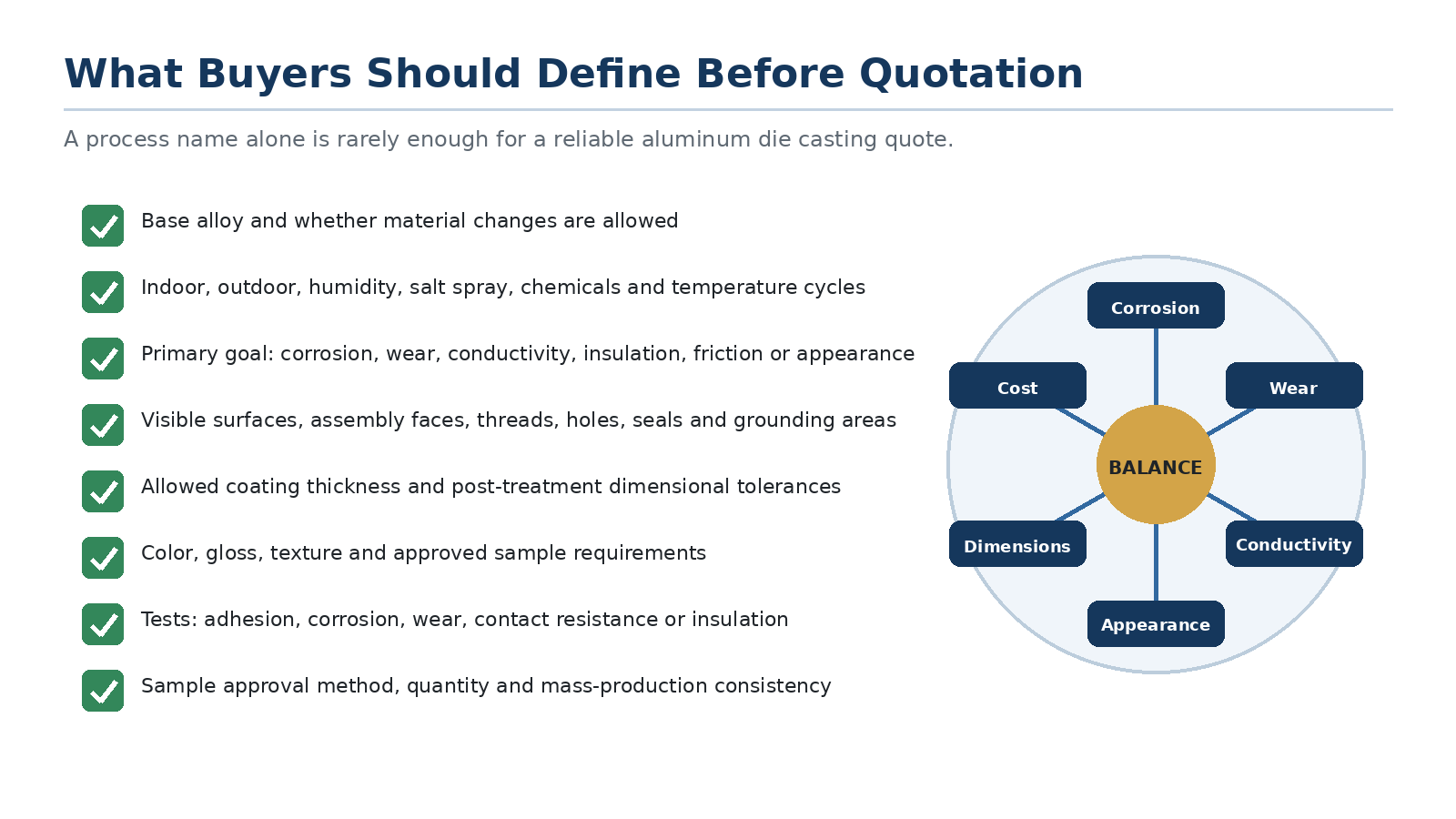
A buyer does not always need to choose one final surface process at the first inquiry. However, the project should clearly state what the surface must achieve and which functions cannot be sacrificed. The following information affects the process route, sample plan, quotation, inspection method, and mass-production risk:
Base material and alloy requirements, including whether material changes are allowed to meet the surface target.
Service environment: indoor, outdoor, humidity, salt spray, chemicals, temperature cycling, abrasion, or friction.
Primary objective: corrosion resistance, wear resistance, conductivity, insulation, low friction, color, gloss, or texture.
Visible surfaces, assembly faces, threads, holes, sealing surfaces, grounding points, and areas that must not be treated.
Allowed coating or oxide thickness and the dimensions and tolerances that must still be met after treatment.
Color, gloss, texture, color-difference limits, and approved sample requirements.
Required validation: adhesion, corrosion, wear, contact resistance, insulation, or another customer standard.
Sample approval method, expected quantity, and mass-production consistency requirements.
A structured RFQ checklist for custom OEM aluminum die casting parts helps a custom aluminum die casting supplier evaluate the surface requirement together with geometry, alloy, tolerance, quantity, and assembly conditions instead of treating finishing as a last-minute add-on.
8. Good Surface Engineering Is a Balance, Not a Search for the Strongest Process
Surface treatment should be reviewed with the casting structure, alloy, substrate condition, machining, threads, visible areas, assembly, inspection, and packaging. It should not be appended at the end of an aluminum die casting quote as a single process name with no acceptance logic.
Powder coating, paint, polishing, anodizing, electroplating, conversion coatings, and specialized functional layers should be evaluated against material, environment, performance target, acceptable cost, and production stability. Whether the work is performed by the die caster or through additional manufacturing support , the approved route should be controlled by drawings, samples, functional requirements, and agreed acceptance criteria.
The best surface treatment is not the process that sounds strongest. It is the process, or combination of processes, that gives the part the required protection and function while keeping appearance, dimensions, cost, and mass-production consistency within an acceptable range.
Related HSX evidence
Define the surface problem, then connect it to the part and the correct finishing boundary.
Continue reading
Convert general guidance into a project-specific review.
Share a drawing, 3D file, sample or requirement so HSX can review the actual geometry, process route and finishing boundary.