HSX BLOG
Why Do Cold Shut Defects Appear on Aluminum Die Cast Parts?
Quick answer: A cold shut forms when separate molten-metal flow fronts meet but do not fuse into a fully continuous section. Four conditions to review first are poor fusion at the meeting line, low molten-metal or die temperature, an unsuitable gate/runner position or excessive flow length, and low filling speed. The
Quick answer: A cold shut forms when separate molten-metal flow fronts meet but do not fuse into a fully continuous section. Four conditions to review first are poor fusion at the meeting line, low molten-metal or die temperature, an unsuitable gate/runner position or excessive flow length, and low filling speed. The visible line may be superficial, but a true cold shut can also indicate a locally weak joining interface.
Cold shuts are a recognizable defect in the aluminum die casting process . They often appear as narrow, irregular, recessed lines on the casting surface. Some remain shallow; others can extend deeper into the section. Because the edges can look relatively smooth, a cold shut may be confused with an ordinary surface trace when the part is inspected only by appearance.
For a buyer, the important question is not simply whether a line is visible. It is whether the line represents a surface mark or a weak interface between two metal fronts. If the latter is true, grinding away the visible trace does not automatically restore the underlying metal continuity.
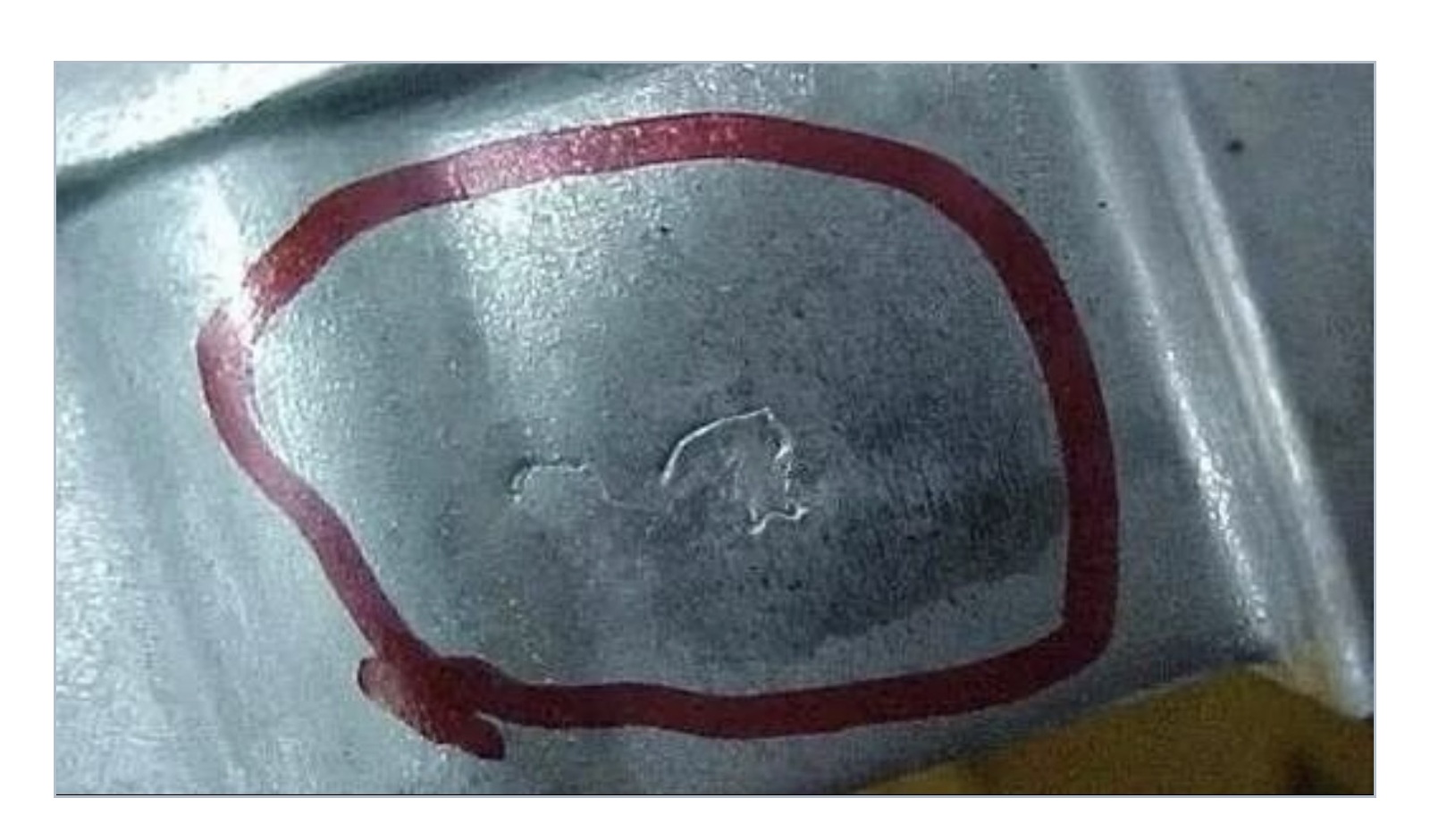
1. What Does a Cold Shut Look Like on an Aluminum Die Casting?
A cold shut usually appears as a fine, narrow and irregular line that sits slightly below the surrounding as-cast surface. Depending on severity, the line can be non-through or can extend farther into the casting section. In some locations the meeting edge looks smooth rather than jagged, which is one reason the defect can be mistaken for a flow mark, scratch or harmless cosmetic seam.
Visual inspection alone does not establish whether the defect is structurally important. Location matters. A line on a low-stress cosmetic area is a different risk from the same defect crossing a mounting boss, bolted joint, vibrating bracket, sealing interface or another load-sensitive region.
2. How Does a Cold Shut Form?
The core mechanism is incomplete fusion. Molten aluminum can split into separate flow fronts as it moves around ribs, holes, bosses or other cavity geometry. Those fronts later meet. If they still have sufficient heat and fluidity, they can form a continuous section. If they have cooled too much or the meeting condition is unfavorable, the interface may remain only weakly joined.
This is why a recurring cold shut should be treated as a filling-system question. The investigation needs to work backward from the defect location: where did the metal enter, why did the flow divide, where did the fronts meet, and what thermal and flow condition did they have at that moment?
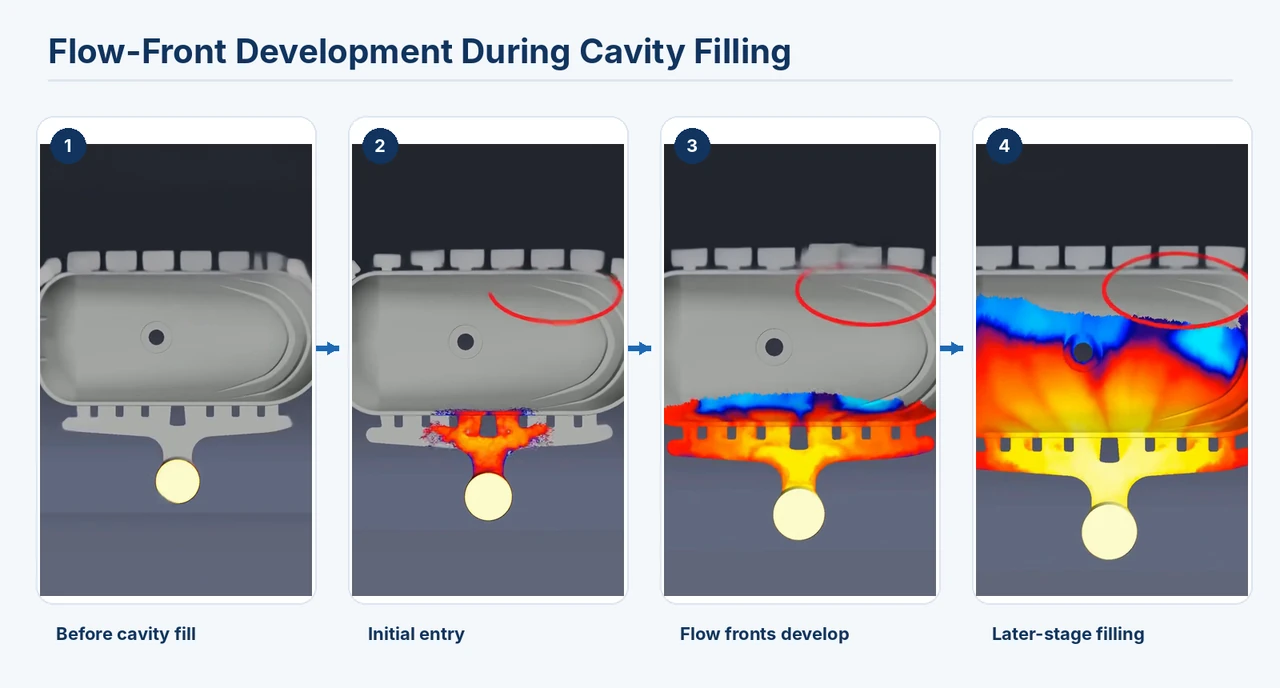
3. Cause One: Two Metal Flow Fronts Meet but Do Not Fully Fuse
This is the defining condition behind a cold shut. In a complex die cavity, two streams of aluminum can approach the same area from different directions. The surfaces of those streams may already have cooled or partially solidified by the time they meet. The cavity can therefore appear filled while the meeting line still lacks a strong, continuous bond.
When the same defect repeats in the same position, the first useful questions are where the flow fronts originate, what geometry separates them, where they rejoin, and whether the meeting zone is a late-fill or low-energy region. That line of reasoning is more useful than treating every cold shut as a generic temperature problem.
4. Cause Two: Molten-Metal Temperature or Die Temperature Is Too Low
Molten aluminum loses heat as it travels through the shot system, runner, ingate and cavity. If the molten-metal temperature is too low, its usable fluidity can fall before the last flow fronts meet. A die that is too cold can accelerate the same heat loss at the cavity surface.
Two cooler fronts can still occupy the same region without forming the same quality of fusion as two fronts that meet inside a stable process window. The correct response is therefore not simply to raise one temperature blindly. Molten-metal temperature, local die temperature, wall thickness, cycle condition and actual filling behavior need to be reviewed together.
5. Cause Three: The Gate or Runner Position Is Unsuitable, or the Flow Path Is Too Long
The gating system determines where aluminum enters the cavity, how far it travels and where separate fronts are likely to meet. If the ingate position forces metal to travel an unnecessarily long route, or if the geometry creates a late-fill meeting zone far from the gate, the fronts may arrive there after losing too much heat and fluidity.
Long parts, thin sections, flow around large openings or ribs, and areas where multiple streams rejoin deserve particular attention. If a cold shut appears repeatedly in one fixed area across sampling or production, the gate, runner, flow path and meeting zone should be reviewed before the team keeps changing machine settings.
6. Cause Four: Filling Speed Is Too Low for the Part
Filling speed affects how long molten aluminum remains in motion before the cavity is complete. If the filling condition is too slow for the geometry, the metal can lose more heat before later flow fronts meet. The result can be a seam-like area where the cavity is physically filled but the joining condition is weak.
There is no single filling-speed value that is correct for every aluminum die casting. The required condition depends on part geometry, wall thickness, alloy, gate area, runner design, die temperature and the complete shot profile. A useful aluminum die casting manufacturer should evaluate the filling window for the actual part rather than apply one fixed setting to unrelated components.
7. Why Should Buyers Care About a Cold Shut?
A buyer inspecting a production lot may see only a line and ask whether the part should be rejected. The answer depends on what the line represents and where it is located. If it is only a superficial visual trace, the concern may be mainly cosmetic. If it is a true cold shut, the line can mark a locally weak joining interface.
That distinction matters when the part will be bolted, clamped, vibrated, impacted or used as a structural connection. A visible line can sometimes be ground or polished away, but surface removal does not prove that the underlying fusion is sound. The defect therefore needs to be evaluated against the function of the part, not only its appearance.
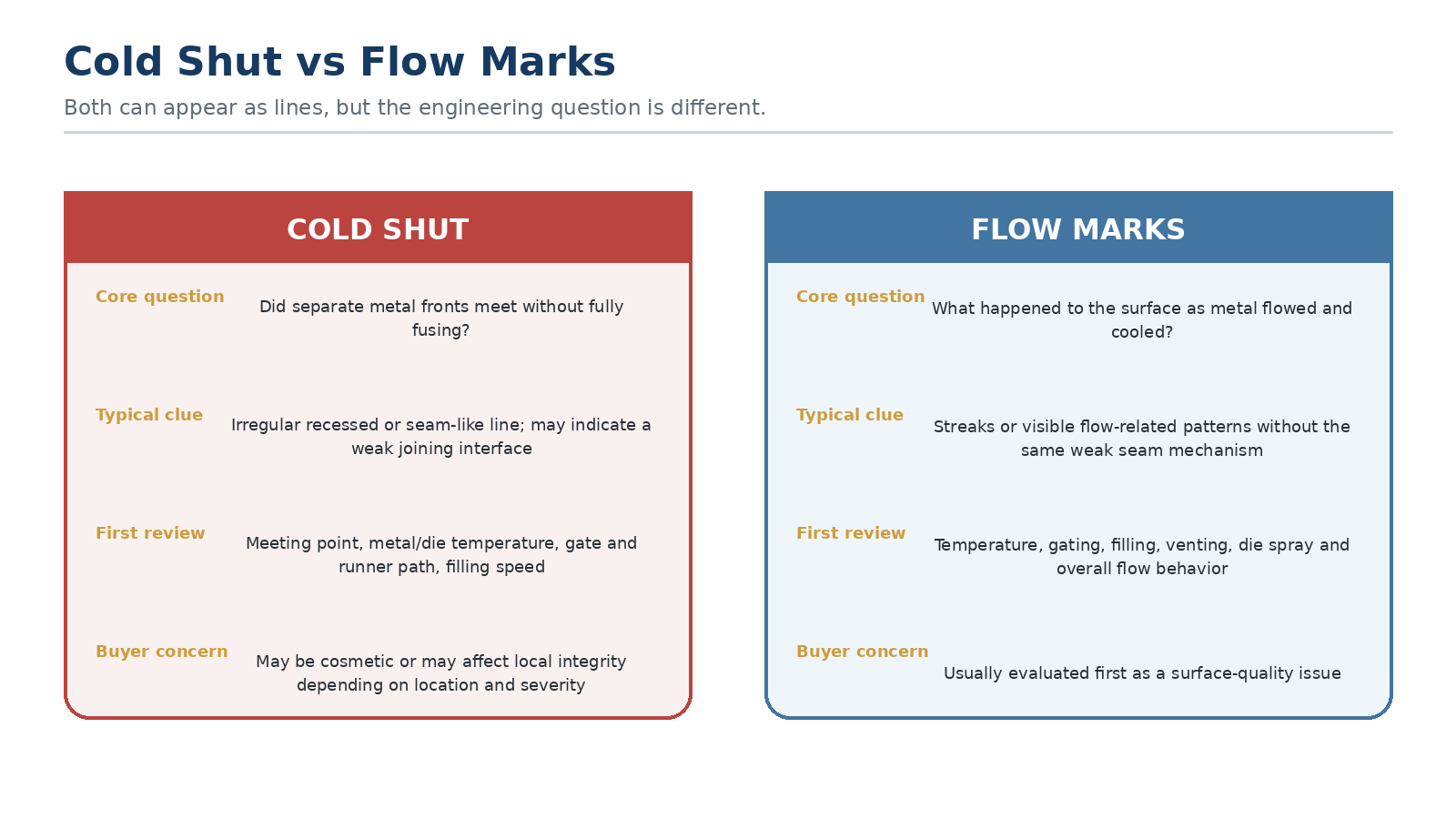
8. Cold Shut and Flow Marks Are Not the Same Defect
Cold shuts and flow marks on aluminum die cast parts can both appear as lines or visible surface patterns, so the two are sometimes confused. The engineering question is different.
For a cold shut, the key question is whether separate metal fronts met without fully fusing. For a flow mark, the first question is how the surface recorded the filling and cooling behavior of the metal. Likewise, fine lines that repeat as a growing network should be distinguished from net-like heat-check marks caused by the die surface . Correct identification matters because each defect sends troubleshooting in a different direction.
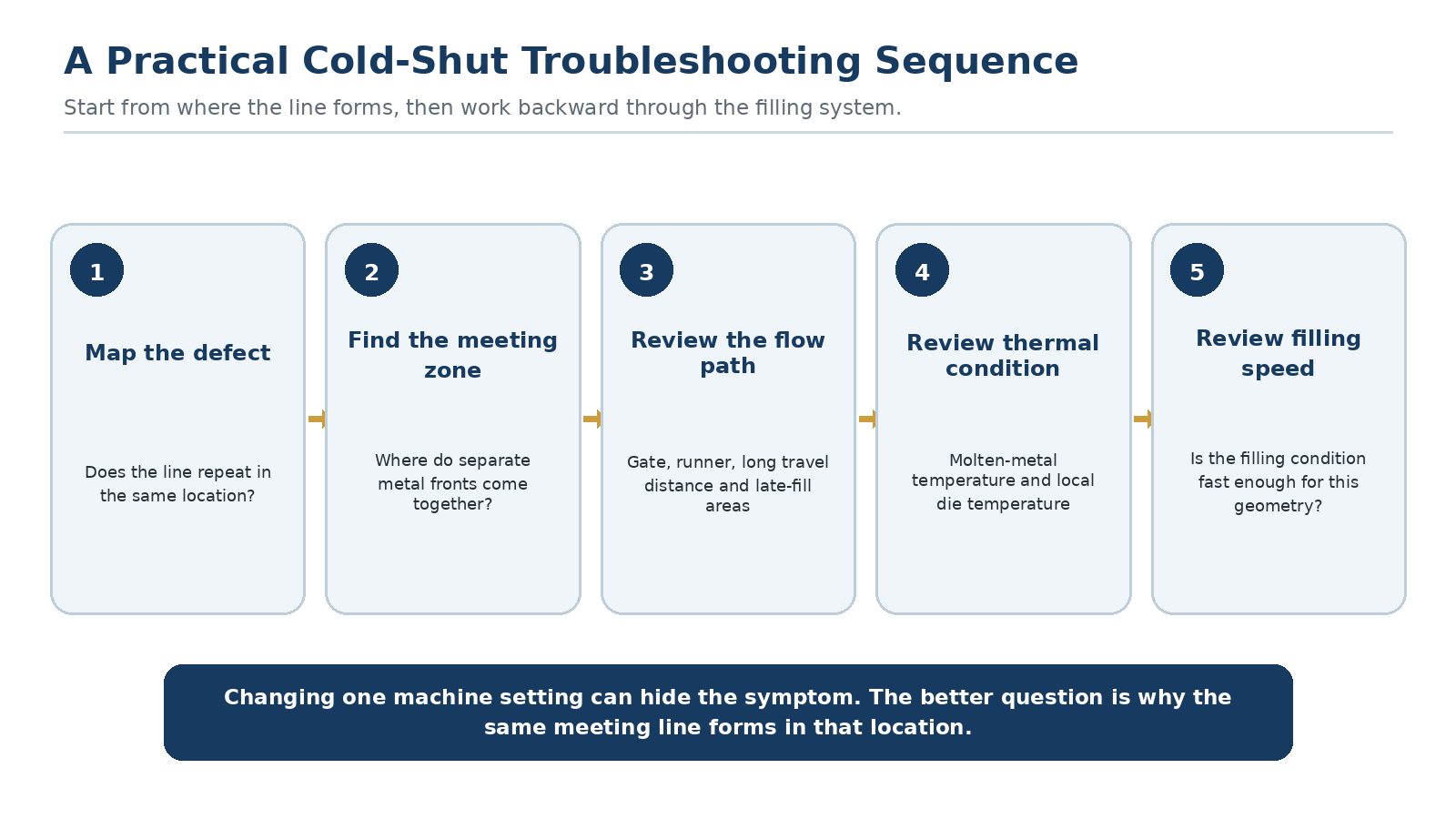
9. A More Practical Troubleshooting Sequence
Based on the production experience used for this article, a more useful sequence is to start with the defect location, identify where the metal fronts meet, review the gate and runner path, check whether the flow distance is excessive, and then review molten-metal temperature, local die temperature and filling speed.
This approach avoids a common trap: changing one machine parameter until the line becomes less visible without understanding why it forms in that location. SOPs define the normal production baseline, but the actual casting, die and filling condition still need experienced shop-floor judgment when the defect repeats.
10. What Does a Cold Shut Reveal When Comparing Aluminum Die Casting Suppliers?
Cold shuts can also reveal how a supplier approaches manufacturing problems. When buyers compare a custom aluminum die casting supplier, the useful question is not only whether the factory has die casting machines, tooling support and secondary operations. A stronger question is: if a cold shut appears in one fixed area during die trial or mass production, how will the team identify the cause?
A supplier that responds only with “raise the temperature” is using a much narrower troubleshooting model than one that reviews the metal meeting line, gate and runner position, flow distance, die temperature, molten-metal condition and filling speed together. This broader process-control mindset is also part of why quality problems can still occur even at a one-stop aluminum die casting supplier if production changes are not identified and contained early.
The same reasoning applies to an aluminum die casting quote. Two parts with similar weight can carry very different manufacturing risk because their wall thickness, geometry, gate position and metal-flow path are different. For cold-shut defects, the valuable part of supplier engineering is not simply naming the defect. It is explaining why that joining line forms in that location and whether the correction belongs in the gating system, thermal window, filling condition or a combination of them.
Related HSX evidence
Connect the defect mechanism with casting evidence and the approved project route.
Continue reading
Convert general guidance into a project-specific review.
Share a drawing, 3D file, sample or requirement so HSX can review the actual geometry, process route and finishing boundary.