HSX BLOG
Why Can the Same Die-Release Setup Work on One Aluminum Die Casting Part but Fail on Another?
What buyers should expect from an aluminum die casting manufacturer when a new custom part moves from drawing review to die trial and stable production. The same die-release setup can behave differently from one aluminum die casting part to another because wall thickness, cavity depth, ejection resistance, cycle time,
What buyers should expect from an aluminum die casting manufacturer when a new custom part moves from drawing review to die trial and stable production.
The same die-release setup can behave differently from one aluminum die casting part to another because wall thickness, cavity depth, ejection resistance, cycle time, die temperature, spray coverage and finishing requirements change how the release film works on the die. At HSX, the initial dilution ratio is treated as a die-trial starting point and is revalidated during continuous production instead of being copied blindly from an older part.
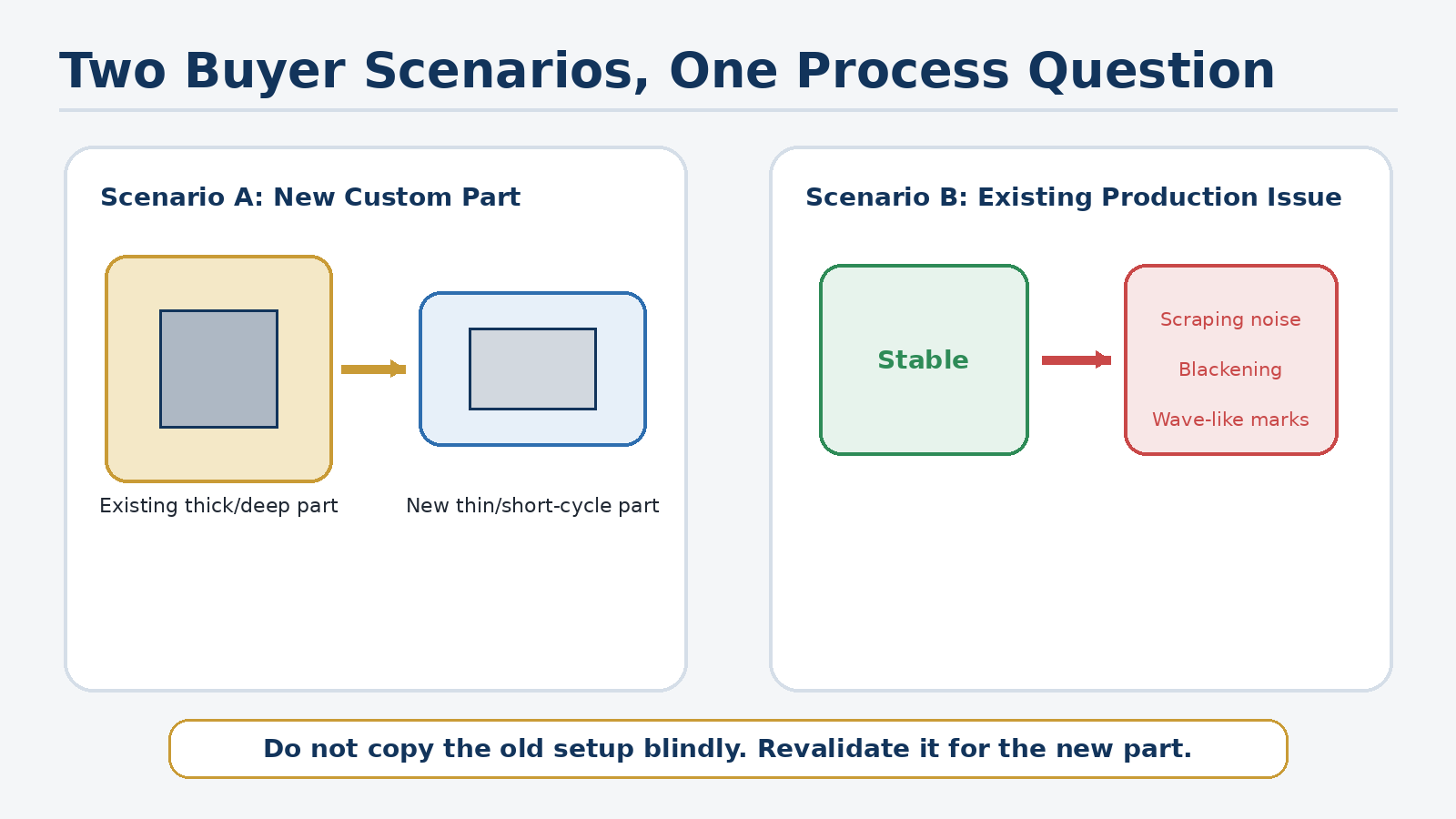
Two Buyer Scenarios That Require a Fresh Process Review
Buyers commonly meet one of two situations. In the first, a new custom aluminum die casting project is developed after an older part has already reached stable production. The alloy may be similar, but the new part has different wall thickness, cavity depth, ejection resistance, cycle time or appearance requirements. Copying the old die-release setup can therefore create new risks.
In the second situation, an existing part begins to show unstable results during production. The buyer may see blackening, wave-like surface marks, localized roughness or inconsistent dimensions. The factory may also hear abnormal friction or scraping during ejection. These signs do not prove that the release agent is the only cause, but they are reasons to review whether the release-agent type, dilution ratio and spray condition still match the part.
What the Buyer Defines and What the Factory Controls
The customer normally defines the product requirements early: the drawing, critical appearance surfaces, assembly interfaces, and whether the part will be sandblasted, powder coated, painted or polished. These surface-finishing requirements tell the aluminum die casting manufacturer what the finished part must look like and which surface conditions are unacceptable.
The factory then converts those requirements into a manufacturing route . Die-release selection, dilution ratio, spray volume, spray path, blow-dry condition and local die temperature are production controls. A buyer should not be expected to choose the exact release-agent ratio. A capable factory should establish and validate it for the specific casting.
Shop-Floor Labels Such as “Oil-Leaning” and “Water-Leaning” Are Not Quality Grades
On the shop floor, operators may describe one water-diluted release-agent concentrate as more oil-leaning and another as more water-leaning. In the production experience discussed here, both are diluted with water before use. The labels describe practical differences in film behavior, lubrication and cooling rather than a strict chemical classification.
A product described as more oil-leaning may also cost less than a more water-leaning alternative, but a lower purchase price does not automatically mean poor performance. The relevant question is whether the film and cooling behavior match the casting, the cycle and the required surface result.
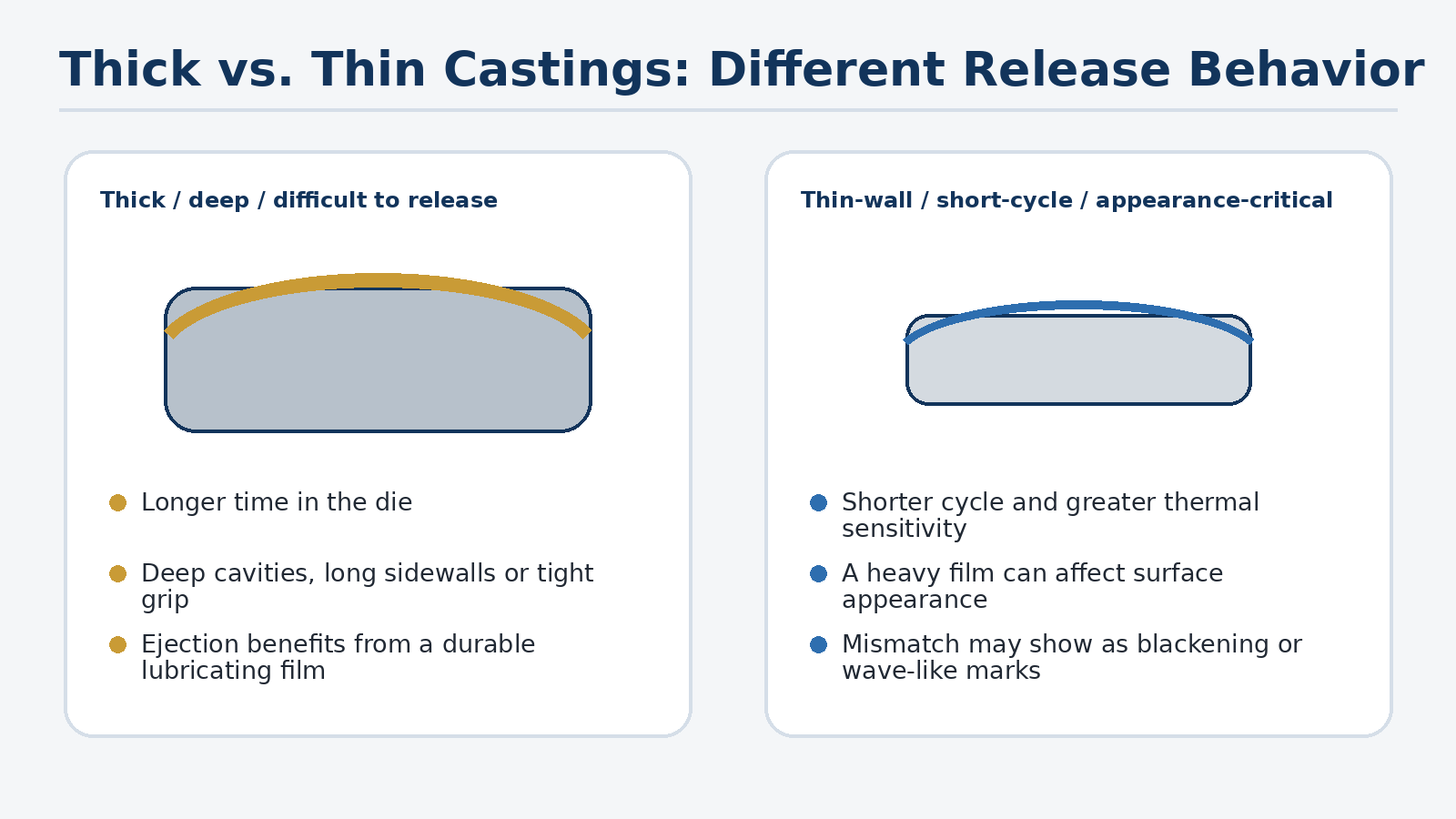
Why Thick and Thin-Wall Castings Need Different Die-Release Behavior
A thicker part, a deep cavity, a long sidewall or a tightly gripping geometry may remain in the die longer and may resist ejection more strongly. Under those conditions, a more persistent lubricating film can help the casting separate from the die during opening and ejection.
A thin-wall or short-cycle part behaves differently. The time in the die is shorter, and its surface condition can be more sensitive to local cooling and to a film that is too heavy for the cycle. Based on our production experience at HSX, copying a heavier release film from a thick part to a thin part can contribute to blackening, uneven color or wave-like surface marks.
This is not a rule that every thick part requires one product and every thin part requires another. Part geometry, die temperature, molten-metal condition, filling behavior and ejection must still be considered together.
Why One Dilution Ratio Cannot Be Copied from Part to Part
Even when the same release agent is used, the dilution ratio that works on one casting may not be the correct ratio for another. Wall thickness, cavity depth, local heat concentration, cycle time, spray coverage, ejection resistance and finishing requirements all change the way the film behaves on the die.
A ratio that is stable on an existing part is a useful reference, not a guaranteed answer for a new mold. Using one fixed ratio for every product may either leave insufficient lubrication or create an unnecessarily heavy film and excessive cooling.
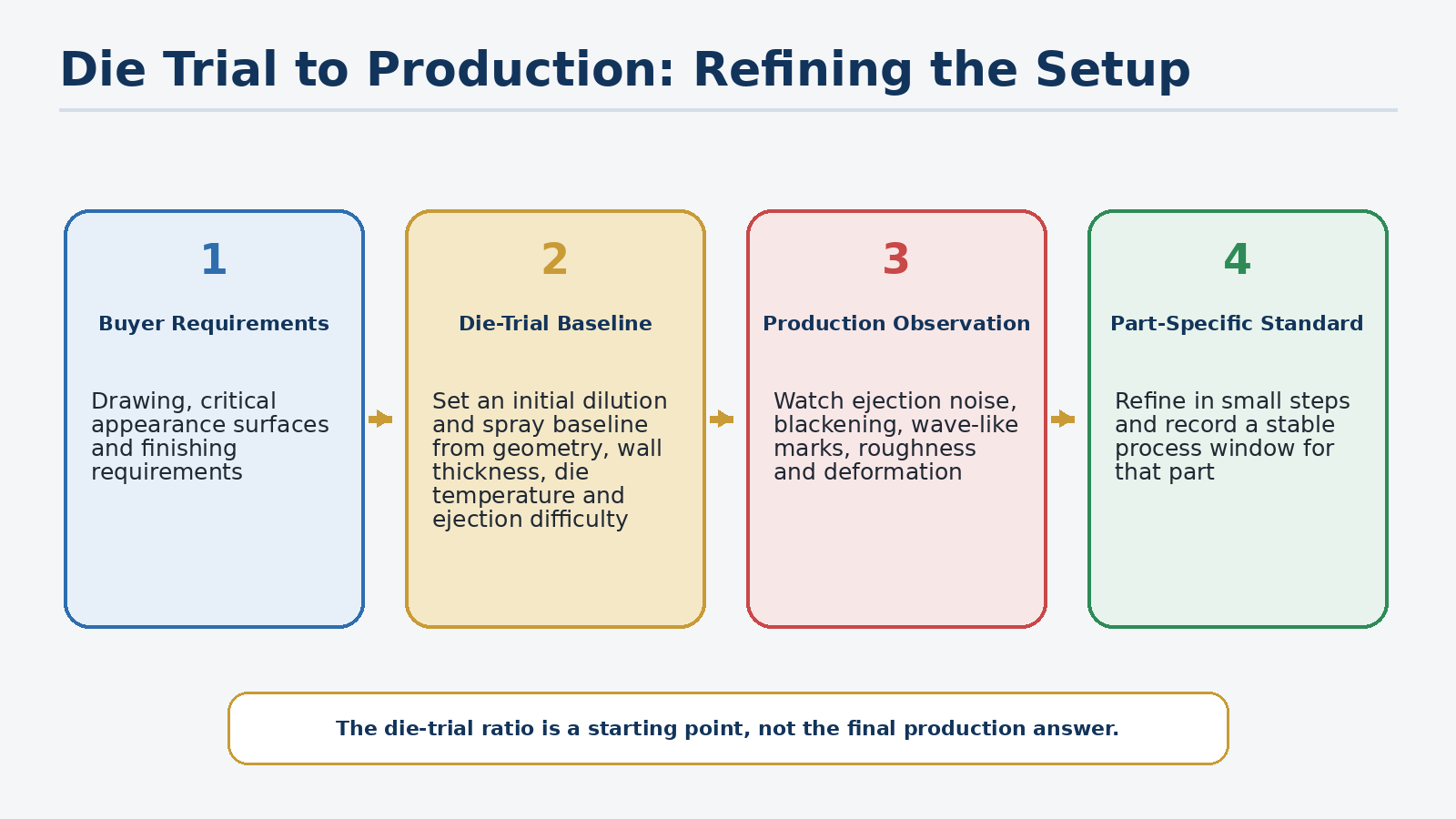
How HSX Moves from Die Trial to Stable Production
During die trial, HSX establishes an initial dilution ratio and spray condition based on the drawing, part structure, wall thickness, die temperature and expected ejection difficulty. This first setting is an engineering baseline, not the final mass-production standard.
When continuous production starts, the thermal balance and cycle repeatability become clearer. HSX then refines the ratio and spray settings in small steps, changing one controlled factor at a time and recording the result. The goal is to create a stable process window for that specific part rather than to preserve a trial setting simply because it produced an acceptable first sample.
Four Production Signals HSX Watches
Ejection sound: a normal part usually separates in a repeatable way. Friction, scraping or other abnormal sounds suggest that the release condition, die surface, draft or ejection system should be reviewed.
Surface color: blackening, uneven color or wave-like marks can indicate that the film, cooling and cycle are not well matched, although die temperature and filling conditions must also be checked.
As-cast surface condition: raised particles, localized roughness or other surface abnormalities are signals to stop and review the process before the part enters finishing.
Dimensional stability: if a part bends, warps, develops a local depression or deforms during ejection even after normal spraying and blow-drying, the factory must first rule out mold, cooling, geometry and ejection problems before attributing the result to the release-agent setting.
What Must Be Ruled Out Before Blaming the Die-Release Setup
A release-agent adjustment should never become a shortcut for every casting defect. Before changing the dilution ratio repeatedly, HSX also checks the die surface, draft, cooling circuits, local die temperature, ejector condition, molten-metal temperature, filling behavior, runner and venting conditions.
This boundary matters to buyers. A factory that changes only one consumable without checking the rest of the process may temporarily hide a symptom while the real cause remains.
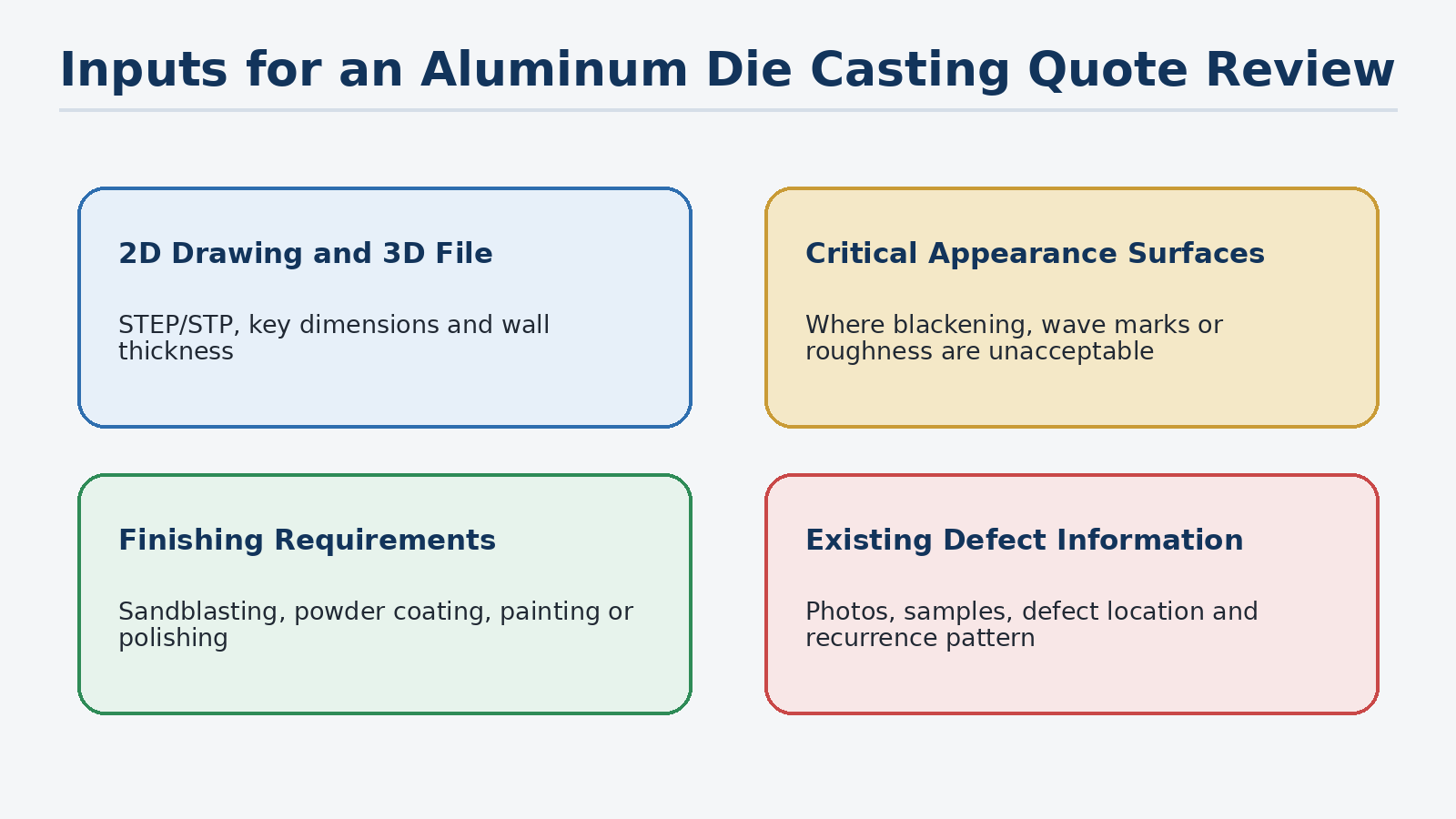
What to Include in an Aluminum Die Casting Quote Request
An aluminum die casting quote is more useful when it includes enough information for both commercial pricing and process review. Helpful inputs include a 2D drawing, a STEP or STP file, main wall thickness, critical appearance surfaces, finishing requirements, annual or batch quantity, and photos or samples of any existing defect.
When comparing an aluminum die casting manufacturer or a custom aluminum die casting supplier, buyers should ask whether the factory will validate process settings by part, distinguish die-trial settings from production settings, and review surface requirements before tooling and sampling decisions are finalized.
The Goal Is a Part-Specific Production Window
The practical lesson is not that one release-agent category is always better than another. The lesson is that the setup must match the casting. A process that works on a thick, difficult-to-release part may create surface problems on a thin, short-cycle part, while a light film that suits a thin part may be insufficient for a deep or tightly gripping geometry.
For buyers, this is why a stable custom aluminum die casting project depends on more than material and machine tonnage. The factory must connect the drawing, appearance standard, die trial, production observations and finishing requirements into one repeatable process window.
Related HSX evidence
Evaluate the symptom against the actual casting route rather than transferring one setup between parts.
Continue reading
Convert general guidance into a project-specific review.
Share a drawing, 3D file, sample or requirement so HSX can review the actual geometry, process route and finishing boundary.